


Table of Contents
- What 97% On-Time Project Delivery Actually Means for a Legal Office
- The Law Office Renovation Timeline: What Belongs in It
- Building a Commercial Renovation Project Schedule That Holds
- Pre-Construction Planning for Commercial Projects: The Step Most Firms Skip
- How to Compare Commercial Painting Contractors for a Legal Office
- How Contractors Handle Delays During an Office Renovation
- Measuring Delivery Performance: Benchmarks Beyond the Percentage
- Conclusion
- Frequently Asked Questions
Last Updated: October 21, 2026
What 97% On-Time Project Delivery Actually Means for a Legal Office
Ninety-seven percent on-time project delivery is a completion rate, not a marketing slogan. It means that out of every hundred milestones a contractor commits to, ninety-seven land on or before the promised date. At IJS Limited Construction, we report that figure against our own renovation work because legal offices cannot absorb the cost of a missed handover.
The number only matters if you know how it is calculated. Most firms never ask. That is the first mistake.
Why Law Firms Need a Different Delivery Standard
A law office is not a generic commercial space. It holds confidential client files, secure records, and equipment that cannot sit in a dusty corridor for a week.
The standard delivery model assumes the tenant can absorb disruption. Legal tenants cannot. A workable schedule treats billable hours as the constraint, not an afterthought. That single shift changes how you plan phases, sequence trades, and define what “on time” even refers to.
The Law Office Renovation Timeline: What Belongs in It
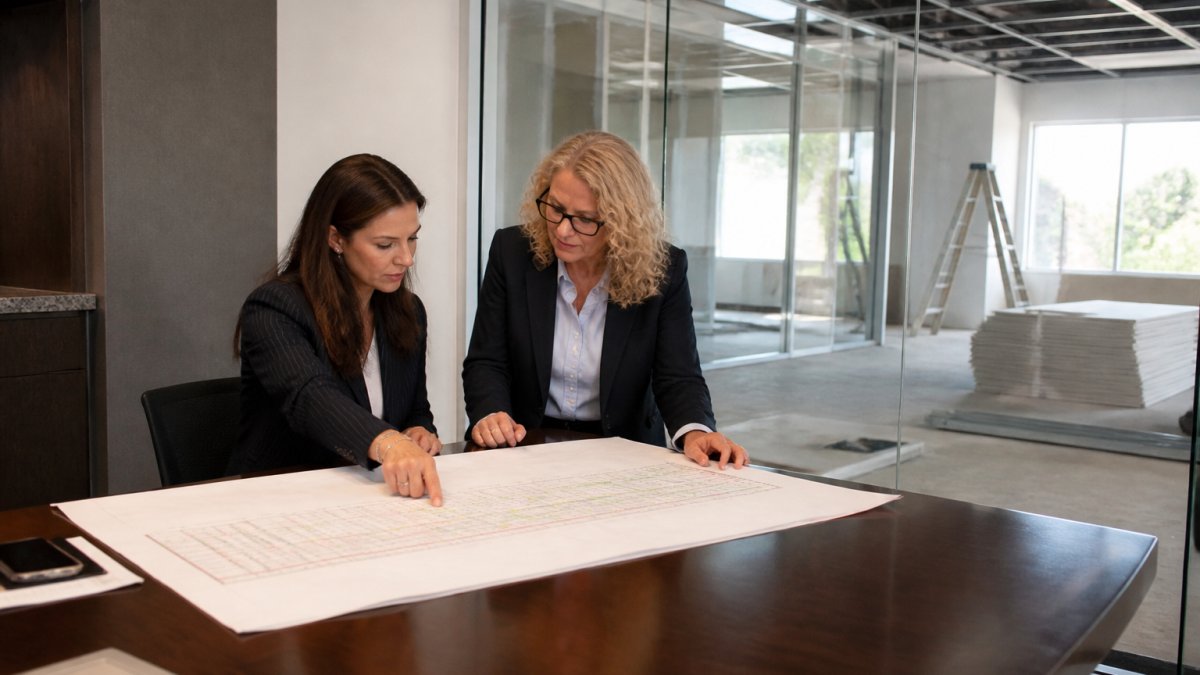
A law office renovation timeline is the dated sequence of design approvals, permitting, demolition, rough-in, finishes, inspections, and handover for a legal tenant space. It should list every phase with a start date, a completion date, and a named owner.
Phases That Protect Billable Hours
Sequence work so the noisiest, dirtiest tasks happen when the office is quietest. A practical order looks like this:
- Pre-construction survey and design sign-off before any material is ordered
- Permit submission and approval tracked as its own dated phase
- Demolition and rough-in scheduled for evenings or weekends where the lease allows
Each phase gets a buffer. Buffers are not padding; they are the reason a schedule survives a surprise.
Building a Commercial Renovation Project Schedule That Holds
A commercial renovation project schedule holds when it is built backward from the move-in date and every dependency is written down. Contractors who build forward from “when can we start” produce optimistic calendars. Contractors who build backward from “when must we be finished” produce schedules that account for inspection queues and material lead times.
The difference shows up in week six, not week one.
Ask for the schedule’s critical path, the chain of tasks where any slip pushes the whole handover. A contractor who cannot name it in the meeting does not have one.
Pre-Construction Planning for Commercial Projects: The Step Most Firms Skip
Pre-construction planning for commercial projects is the phase where scope, budget, permits, and site conditions are confirmed before crews mobilize. It is the step most firms skip because it produces no visible progress. It also prevents most of the delays that follow, and it is where the implementation work that determines whether a schedule actually holds gets done.
What Belongs in It
- A written scope with allowances stated in dollars, not adjectives
- A site walk confirming access, power, elevator capacity, and existing conditions
- Permit requirements mapped to the authority having jurisdiction, with submission dates on the calendar
Skipping this phase is how a two-week drywall job becomes a six-week argument.
The Implementation Sequence Most Firms Skip
Pre-construction is not a meeting; it is a sequence. A workable order looks like this:
- Scope lock, signed scope document with allowances in dollars and an exclusions section.
- Site and systems survey, confirm electrical capacity, HVAC zoning, data cabling paths, and fire-life-safety requirements for an occupied legal space.
- Permit mapping, identify every approval required, the review timeline for each, and the inspection sequence that follows.
- Procurement plan, long-lead items (casework, glazing, specialty doors, security hardware) ordered against the schedule, not against the crew’s availability.
- Mobilization plan, phasing, containment, after-hours access, and staff relocation mapped suite by suite.
- Change-control protocol, who can approve a change order, in what form, and within what dollar threshold.
Each step produces a document. If a contractor cannot show you the documents, the phase did not happen.
Adoption and Change Management on the Legal-Office Side
The contractor’s plan only works if the firm adopts it. That means:
- A single internal owner. One office manager or operations lead empowered to approve schedule changes and relocate staff. Committees stall projects.
- Staff communication before mobilization. Attorneys and paralegals need to know which suite is affected, when, and where they will work. Surprise disruption is the most common cause of client-facing delays.
- Integration with the firm’s calendar. Schedule noisy phases around deposition weeks, trial dates, and filing deadlines, not around the contractor’s convenience.
Trade-Offs to Decide Up Front
Pre-construction forces choices that are cheaper to make early:
- Speed versus phasing. Compressing the schedule usually means more after-hours work, which raises cost and coordination burden.
- Allowance size versus change-order risk. Tight allowances lower the bid but raise the odds of change orders later.
- Containment versus disruption. Full-height containment protects occupied space but slows the crew; partial containment is faster but riskier for a law library or records room.
Documenting these trade-offs in the pre-construction package is what separates a schedule that holds from one that collapses in week six.
A bid with no exclusions section is not cheaper. It is a bid where every unknown becomes a change order later, and change orders are where schedules die.
How to Compare Commercial Painting Contractors for a Legal Office
Compare commercial painting contractors on schedule discipline, surface preparation, and insurance, not on the lowest bid. A legal office needs clean lines, low-odor products, and crews who understand that a law library cannot be wrapped in plastic for a month.
U.S. Occupational Safety and Health Administration guidance on workplace safety and health sets the baseline for chemical handling and site safety on occupied commercial jobs. Ask every bidder how they meet it.
Questions That Separate Specialists from Generalists
Put these to each contractor in writing:
| Question | What a strong answer sounds like | Red flag |
|---|---|---|
| How do you protect occupied space? | Named containment method, daily cleanup | “We’ll be careful” |
| Who owns the schedule? | A named project manager | “The crew figures it out” |
| How do you handle a delay? | Written notice, revised dates | Verbal reassurance |
| What is your on-time record? | A defined metric and method | A round number, no method |
A bid with no exclusions section is not cheaper. It is a bid where every unknown becomes a change order later, and change orders are where schedules die.
How Contractors Handle Delays During an Office Renovation
Delays get handled well when the contract defines notice, cause, and remedy before work starts. A contractor who flags a slip the day it happens, in writing, with a revised date, is protecting your schedule.
Expect a written delay log covering material shortages, inspection holds, and access restrictions. Review it weekly. A delay you can see early is a delay you can absorb.
Measuring Delivery Performance: Benchmarks Beyond the Percentage
A delivery rate means nothing without the definition behind it. The competitive gap in this space is that almost no one publishing a 97% on-time figure explains how it is calculated, what it includes, or over what period. That is the first thing a legal office manager should demand, and the first thing a credible contractor should volunteer.
Define the Metric Before You Compare It
On-time delivery can mean at least four different things, and the number swings wildly depending on which one is used:
- Milestone on-time rate, the share of scheduled milestones (permit approval, rough-in complete, drywall hung) finished on or before the committed date.
- Final handover on-time rate, whether the whole project reached substantial completion by the contract date. This is the strictest and least flattering version.
- Task-level completion rate, the share of individual schedule tasks closed on time. Easy to inflate because small tasks absorb slippage.
A contractor claiming 97% should be able to say in one sentence which of these it is, the measurement window (rolling 12 months, trailing 24 months, or per-project), the sample size (number of projects or milestones), and whether client-caused delays and force-majeure events are excluded. If any of those four answers is missing, treat the percentage as a marketing figure, not a performance record.
The KPI Set a Legal Office Should Track
Whether you are evaluating a renovation contractor or a legal project management platform, the same measurement discipline applies. Ask for these five numbers and the method behind each:
| KPI | What it measures | Why it matters to a legal office |
|---|---|---|
| On-time completion rate | Share of milestones or handovers met by committed date | The headline number, only meaningful with a stated method |
| Deadline slippage | Average days late per missed milestone | Distinguishes a firm that misses by one day from one that misses by three weeks |
| Cycle time | Elapsed days from phase start to phase close | Reveals whether buffers are real or absorbed silently |
| Workload variance | Spread between planned and actual crew or staff hours | Flags under-resourced phases before they slip |
| Rework rate | Share of completed work reopened after inspection or punch list | The hidden cost driver behind most “on-time” claims |
A firm that tracks all five can defend its delivery rate. A firm that tracks only the headline number is guessing.
How to Verify the Claim
Ask for a one-page delivery scorecard covering the last 12 months: number of projects, number delivered on time under the stated definition, average slippage in days, and rework rate. Cross-check against client references, specifically, ask two past clients whether the final handover date matched the date in the original contract. Retention is the hardest metric to fake; a contractor with repeat legal-tenant work has usually earned it.
Judge a contractor on three numbers: on-time rate with its method stated, change-order frequency, and client retention. Retention is the hardest one to fake.
Benchmarks to Expect
Most practitioners find that well-run commercial renovation firms report milestone on-time rates in the high 80s to mid 90s and final-handover rates somewhat lower, because final handover absorbs inspection queues and punch-list closeout. A 97% figure is achievable but should come with a stated definition, a sample size, and a measurement window. If a contractor cannot produce those three items on request, the number is a slogan.
Conclusion
The hard part of a legal office renovation is not the drywall. It is holding a date while attorneys keep billing. If you are planning work in a legal space and need a schedule that survives contact with reality, IJS Limited Construction brings owner-level oversight, SBE and CBE certification, and more than 15 years of commercial renovation experience to every project.
Frequently Asked Questions
What should a law office renovation timeline include?
A law office renovation timeline should include pre-construction planning, permitting, demolition, drywall, painting, flooring, electrical and data cabling, furniture installation, and a final punch list. It should also identify quiet periods for noisy work and build in buffer days for inspections. For a 97% on-time project delivery target, the schedule must assign a named owner to each phase and specify how delays are reported. Ask the contractor to show how billable-hour disruption is minimized during each phase.
How can a contractor minimize disruption during a law office renovation?
Contractors minimize disruption by phasing work after hours or on weekends, sealing work zones with plastic barriers and negative air machines, and scheduling noisy tasks like demolition and drywall sanding outside client meeting hours. A detailed commercial renovation project schedule should map each trade to specific days and times. Ask for a written dust-control and access plan, and confirm the crew lead’s daily check-in routine so attorneys know which areas are off-limits.
What does on-time project delivery mean for a commercial renovation?
On-time project delivery means the contractor completes the agreed scope by the contract completion date without shifting the finish line through change orders. For a legal office, it also means the space is usable for client meetings and billable work on the promised date. A 97% on-time rate is a historical performance claim, not a guarantee. Ask the contractor to define how they measure on-time delivery, what counts as a delay, and how they report schedule variance to the client.
How do contractors handle delays during an office renovation?
Contractors handle delays by documenting the cause, notifying the client in writing, and presenting recovery options such as added crew, overtime, or resequencing trades. Pre-construction planning for commercial projects should identify long-lead items like specialty doors, lighting, and data cabling so those are ordered early. The best protection is a schedule with float time and a weekly status report that shows actual versus planned progress. Ask what triggers a formal delay notice and who approves schedule changes.